Tag: tourism

  • An Aboriginal Dreamtime Walkabout Tour in the Daintree

    An Aboriginal Dreamtime Walkabout Tour in the Daintree

    Daintree rainforest tour
    Heaven rays beaming down on the Daintree

    In all my education, I can’t admit to ever definitively learning about Australian history or aboriginal culture. But the history I heard during my time down under was a familiar story, like déjà vu from my American history classes of yesteryear. While its comparing wombats to raccoons, there’s still an underlying theme: colonialism came to the “country” and shattered the indigenous culture through land expansion, disease, re-education or, sadly, annihilation.  The result from both histories is lost languages, forgotten histories, ended bloodlines and an ugly scar on the past.  What does remain are those quirky naming conventions, tribes who were given land reserves, and a new sense of urgency to preserve and share the culture of Australia’s FIRST people: the aborigine.

    This is me thinking out loud right now – and maybe someone reading this may have some insight that I hope you’d share: When I think of Australia, the aboriginal people are among the first five things that come to my mind. For the person outside of the US thinking of traveling to the states – is America’s indigenous culture/Native Americans among the top things you’d consider when planning a trip? My instinct tells me that the aboriginal culture is more woven into Australia’s identity than Native Americans are to the United States. That’s just an unbacked presumption. If it’s true, it’s a damn shame, but I digress…

    Back on topic.

    My point is, I never learned much about the aboriginal culture. While it reminded me of home’s history, there were still some learning moments that I found interesting or surprising during my dreamtime walkabout tour in Queensland.

    Aboriginal smoking ceremony
    How we began our journey into the Daintree rainforest – walking through the smoke from the fire pit before entering.

    To initiate, our guide “invited” us into the forest with a smoke ceremony – he chanted as we walked through a billow of smoke from the fire.  This gave us permission to enter the Daintree Rainforest – the oldest rainforest in the world. One is not permitted to enter the rainforest unattended by one of the tribesman. Today, our aboriginal guide was Dingo. Dingo proceeded by explaining the tale of his friend who entered the rainforest without him and happened upon a stinger plant (very, very painful). Dingo made sure the rainforest had its retribution – he casually avoided telling him the remedy for his pain until he couldn’t take it any longer. I’ve usually been one of the philosophy that it’s better to seek forgiveness than permission… but not when it comes to revered aboriginal land!

    Once inside the rainforest, I could feel the sacredness. Vines coil, leaves shimmer, bold sunrays penetrate like  heavenly spotlights through the branches. It’s an emerald maze. Just knowing the deadly things hidden within the trees would be enough to keep me out without a tribesman. But despite all the dangers,  the forest holds all the remedies.  The rainforest is medicinal and healing. The rainforest possesses everything needed to survive. And we know it’s true, as the aborigine have flourished here for ages.

    Daintree demonstration
    Our guide, Dingo, demonstrating how to use the tools offered by the rainforest – from opening nuts to painting on skin, washing with “soap leaves” and creating shields.

    We traipsed along the trail, stopping as Dingo showed us different plantlife and points of interest. We circled around innocent-looking leaves – it was the stinger plant, one of Queensland’s most toxic plants that can leave redness and a painful stinging sensation for months.  We analyzed a menacing-looking vine with thorns and learned it to be nature’s fishing wire and hook.

    Dingo demonstrated how termite nests are better predictors of the weather than a local meteorologist with their fancy equipment. He passed around tree bark with natural elements to help bug bites. I kept a piece of bark for myself and soothed my red bumps for the rest of the walk.

    A termite hill in the Daintree
    Termite hill, working hard to forecast the weather.

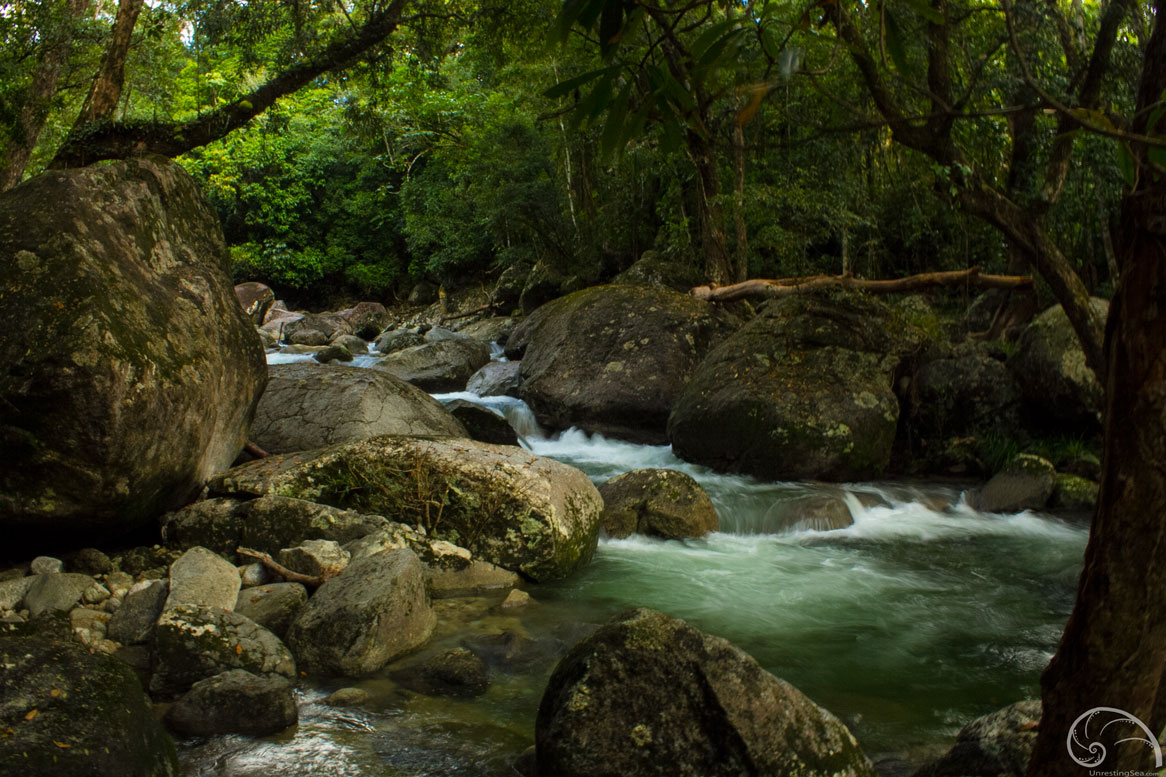
    We made our way to the Mossman River – what a beautiful sight! The water slithered over the round boulders in a mystical fashion – I felt like I encountered a magical fairy pond. Dingo wet different colored rocks and began rubbing them against a boulder. Within seconds, he had created “paint” which he used to dab those iconic aboriginal dots on his arm. Then, he grabbed some leaves, dipped them in the water and began to scrub them vigorously. A sudsy substance began to bubble… SOAP! Nature is so cool.

    The cultural insight I found most fascinating was the kinship model. Tribes marry other tribes. When a couple is married, the husband is not allowed to speak to or be in the presence of the father of his wife.  Contact is not acceptable and should be avoided.  The way husbands can make connections with their “father in law” is through one thing… Have you guessed it yet? Children! When a couple has kids, the children go to their grandfather as a way for the husband to communicate with his bride’s father.  I asked Dingo “why”  and his response was a simple & wonderful, “I don’t know. That’s just how it is.” He laughed as he told us a story where he almost bumped into his wife’s father at an event, and his brother saved the day, avoiding an aboriginal faux pas.

    There might be some husbands out there who would appreciate a system like that, right?

    I loved our dreamtime walkabout tour in the Daintree rainforest. As our group gathered around a picnic table and enjoyed tea & damper at the conclusion of the tour (there’s always tea & damper), I reflected on how wonderful it is that despite a rough past, there’s an effort to keep these cultures alive and shared.  Despite the trauma and persecution these peoples once endured, there’s newfound support for these indigenous communities.   It wasn’t until 2008 that the Australian parliament released an official apology to the lost generations of aboriginal culture (2008… I know, right?). I think it such an honor that I was able to spend the afternoon with this group and I sincerely hope that other travelers visiting Australia consider making an aboriginal cultural experience a top priority.

    Mossman Gorge
    The Mossman Gorge. Seriously beautiful. This is probably one of my favorite photos.

    If you enjoyed, this post, don’t forget to subscribe & connect for future updates!
  • Amanda in Kuranda

    Amanda in Kuranda

    Few words rhyme with my name.  Panda.  Propaganda.  Memoranda.  Now I can add Kuranda to the list.  A town in Tropical North Queensland, a visit to Kuranda  welcomed a slower-paced day of moderate activity.  Everyone’s adventurous spirit needs a vacation day, right?  Kuranda offered the pause to sit back and observe the scenery or meander through the shops of the village, unrushed, unscheduled. After four active days in Sydney, a day trip to Kuranda was the perfect introduction to Queensland.

    Here’s what we did in Kuranda:

    C’mon Ride The Train

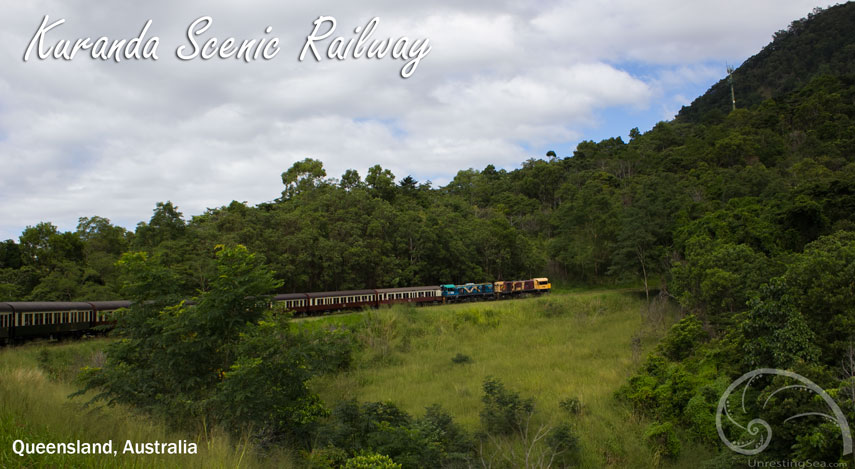
    The day commenced with a leisurely 2 hour train ride from Cairns to Kuranda.  This historic, mechanical chunk of machinery weaved through the rainforest, charged up the mountains and barreled through the tunnels.  Incredible sights unfolded during our journey – from the roaring Stony Creek Falls to the patchwork cane fields to the lush,  towering mountains.  It’s easy to get lost in the setting and forget that Kuranda Scenic Railway wasn’t always a tourist attraction – it first served as a railway for mining, agriculture and passenger transport.

    It took five years to build three sections of this railway including wood & steel bridges and 15 tunnels – remember, this railway was constructed from 1886-1891. Late 1800s! Before we were spoiled with technology, industrial standards and workplace safety.  Yes, many men perished during the railway’s construction and the workers were expected to BYOB (bring your own bush tools).  Some even worked solely with their hands.  Can you imagine digging out 15 tunnels of rock and dirt with your bare hands?  Interestingly, most of the workers were recruits from Italy and Ireland.  Nothing like some good ol’ pasta & potatoes, eh?  It was HARD manual labor.  These men faced adversity from steep land grades, decomposed rock, precarious angles, brutal rainy seasons, food supply shortages, and a lack of understanding of the geology of the earth and its dangers.

    That’s part of the reason this railway is considered such a feat – for its time and the elements, it’s amazing that this endeavor successfully completed.  Development in the 1880s was so hasty, it was believed that many construction projects were fast tracked (pun intended), often derailing (pun also intended) adequate engineering review before plans were approved.  But don’t worry – it seemed to work out for them as I lived to tell the tale of this scenic journey over a century after its maiden voyage.

    Kuranda-Scenic-Railway-Sign

    A small corner of Australia's most photographed bridge.
    A small corner of Queensland’s most photographed bridge.
    The roaring Stony Creek Falls as the train slowly chugged by. I could feel the mist on my face... ahhh. They say that the governor of Queensland once came here to visit after the bride was constructed, but no speeches were made that day due to the thunder of the falls.
    The roaring Stony Creek Falls as the train slowly chugged by. I could feel the mist on my face… ahhh. They say that the governor of Queensland once came here to visit after the bride was constructed, but no speeches were made that day due to the thunder of the falls.
    Soak it in...
    Soak it in…


    Meander in Kuranda

    Once the train arrived in Kuranda, we had quite a few hours allotted to explore.  That’s the beauty of visiting this village – as a completely unscheduled part of our day, we could mosey around town as we pleased.  The mango wine teased and the cafes tantalized.  There are plenty of food options here.  If you’re someone who is anticipating a day trip, I highly recommend checking our their website.  We enjoyed strolling through the older part of Kuranda that I would dub “hipsterville.” This corner of the village of Kuranda has an edgier vibe – seemingly more artistic, alternative, colorful and communal.  It’s further past the main strip of markets. When we walked through it was pretty empty – which is why I’m under the impression that not many people walk far enough to come across it.  Don’t make that mistake!

    He purposefully wore that shirt to match the typeface.
    He purposefully wore that shirt to match the typeface.


    Birdmanda in Birdworld

    While there are various places to visit in Kuranda for an entry fee – Butterfly Sanctuary, Koala Gardens ,etc. – only Birdworld made our itinerary.  I mean, I had to stay true to my nickname, Birdmanda (I’ll save the story for later – but it involves the rapper Birdman & Canadian Geese on Belle Isle).  Birdworld was smaller than I expected, but not so small that I’d consider it inhumane.  These birds seemed to contently fly around the enclosure, snagging food from the hands of visitors.  It was so fun to interact with these birds up close. One bird foe even decided to gnaw on (and break!) my awesome f-stop backpack. Rude! These are my favorite photos from Birdworld:

    Kuranda-BirdWorld

    A casual bro nod? Or friends of a feather?
    A casual bro nod? Or friends of a feather?
    Brat bird gnawed at my backpack and broke it!
    Backpack biter… brat bird

    Kuranda-BirdWorld-3

    Kuranda-BirdWorld-Amanda-Travel-Blogger2


    I’ll be posting plenty more Birdworld photos on instagram, so if you have an account, follow me there!


    Shopping at Open Air Markets

    Kuranda is known for its open air markets. I’m grateful for the suggestion to do most souvenir and gift shopping in Kuranda.  While the kitschy Aussie shops were plentiful (kinda like UGG stores in Sydney… EVERYWHERE), there were some stand out stores that sold legitimate artist wares vs. the cheaper, mass-manufactured items.  Trust me, you’ll know the difference. When you see the exact same didgeridoo and boomerang taunting in 3 different doorways, you’ll know to avoid it. I need to recommend Doongal Local Aboriginal Art (pictured below) – this is where Eric & I purchased our didgeridoo and boomerangs. The items are organized by artist and each artist has his or her own unique style. Not only are the items signed by the creator, each purchase includes an info sheet with a photo and biography about the aboriginal artist. The store attendant even played our didgeridoo for us to make sure we liked the sound quality.

    There’s also a grocery store and bottle shop in Kuranda – so if you’re stranded on a resort like we were, here’s your opportunity to stock up on snacks and wine.

    One of the many kitschy Aussie shops you'll find in Kuranda... get your share of croc skins, kangaroo skins, and bush hats!
    One of the many kitschy Aussie shops you’ll find in Kuranda… get your share of croc skins, kangaroo skins, and bush hats!
    The face of a man about to drop a fat dime on some didgeridoos and boomerangs. ;)
    The face of a man unknowingly about to drop a fat dime on some didgeridoos and boomerangs. ;)


    SkyRail

    The skyrail cableway began the leisurely descent from Kuranda toward Cairns where our shuttles waited.  As we stood in line, we noticed our new friend, Carol, that we had met earlier on the train.  We invited her to join us.  Sharing her company twice was a blessing.  We chatted about Australia and the U.S. We discussed cultural differences, politics, economics, and all interesting and informative conversation we wouldn’t have had unless we spoke with a knowledgeable Aussie.  Our eyes were opened much wider thanks to her.  We glided high above the canopy and the Barron Gorge.  The treetops looked like large fields of broccoli reaching  for the sky.  The cableway made stops at different lookout points – the Barron Falls, a rainforest stroll – a casual break from the heights. Although the cableway is safe, it’s still a stomach lurcher when you look down.

    For the thrill seeker, a day in Kuranda my sound like a boring tourist trap. But for this adverturist, the change of pace and scenery really gave me the chance to inhale deeply and say, “aahh… so THIS is Queensland.”

    Kuranda-Skyrail

    Descending back to Cairns on the skyrail. Wouldja look at that view!
    Descending back to Cairns on the skyrail. Wouldja look at that view!
    Gliding over the Barron River.
    Gliding over the Barron River. Thanks Carol for the pic!
    My snap of the feeble Barron Falls - they were not in full force!
    My snap of the feeble Barron Falls – they were not in full force!